
Technologies and process parameters for uniform and reliable heat treatment of large components
Induction hardening of large components, such as rings, bearings and large shafts, presents specific technical challenges related to temperature control, treatment depth and the uniformity of mechanical properties.
In these applications, treatment quality depends not only on the system’s ability to deliver power and heat the component, but also on the management of the different variables involved in the process.
The induction treatment of rings, large bearing raceways and large shafts is therefore not simply a matter of delivering sufficient power to heat the component.
The result depends on the integrated control of electromagnetic, thermal, metallurgical and mechanical phenomena and, above all, on the expertise required to turn them into a stable industrial process.
Frequency, power density, inductor geometry and positioning, scanning speed, thermal cycle and quenching must be defined and coordinated to achieve the required austenitizing temperature, effective case depth and hardness throughout the entire treated area.
It is this integration of technology, process control and application expertise that makes a truly effective process possible.
As component size increases, so does its value
When heat treating large components, not only does the technical complexity of the process increase, but so do the economic value of the workpiece and the potential impact of defects.
A wind turbine bearing, a slewing ring for a port crane or a ring used in mining equipment represents a high-value component, often associated with long manufacturing lead times, complex logistics and significant replacement costs.
In this context, heat treatment cannot be considered simply another production step. It becomes a critical factor in ensuring long-term reliability and performance. A non-conformity detected after assembly or during operation can result in costly maintenance, equipment downtime and reduced system service life.
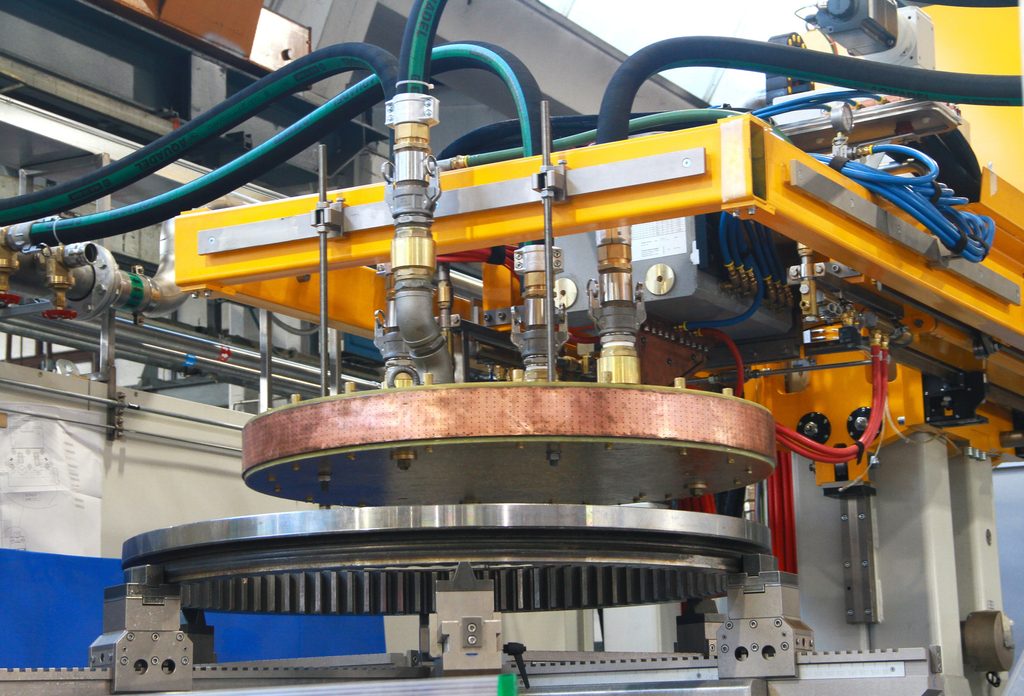
For this reason, in the most demanding applications, success depends not only on the technology used but also on the ability to define and control every process parameter, from inductor design to heating and quenching strategies, to achieve consistent results even on components several meters in diameter. SAET solutions can, for example, treat rings up to 10.5 meters in diameter, providing a concrete indication of the scale and complexity of these applications.
What are the main challenges in induction hardening large components?
Compared to small and medium-sized components, large masses and complex geometries make it more difficult to achieve:
- Uniform temperature distribution;
- Consistent treatment depth;
- Absence of localized overheating;
- Uniform mechanical properties across the entire surface;
- Competitive cycle times;
- Energy costs.
Even minor variations can compromise the final quality of the component or reduce its service life.
Among all these variables, temperature control across the entire component surface is one of the most complex and critical aspects.
The challenge of thermal uniformity in induction hardening
Thermal uniformity is one of the most critical aspects of induction hardening large components. In large bearings and slewing rings used in the wind energy industry, non-uniform temperature distribution across the treated surface can lead to differences in hardness, effective case depth and residual stress distribution.
Even relatively small temperature variations can compromise the uniformity of the component’s microstructure and mechanical properties, increasing the risk of:
- Accelerated wear, particularly in areas subjected to the highest rolling contact stresses;
- Stress concentrations, caused by differences in the properties of the treated areas;
- Crack initiation, which can compromise component integrity;
- Reduced fatigue life, with potential consequences for long-term reliability.
The challenge is therefore to control energy distribution and maintain uniform heating across the entire area to be treated, taking into account geometric variations and the masses involved. Accurate thermal cycle control is essential to achieve repeatable results and metallurgical properties that meet the required specifications.
Eliminating soft zones: the challenge of large rings
During the scan hardening of a complete ring, a particularly critical point occurs where the treatment ends and rejoins the starting point.
In conventional processes, this area may exhibit different metallurgical characteristics from the rest of the raceway, creating a so-called soft zone, a region with lower hardness and non-uniform mechanical performance.
For components used in wind turbines, cranes or large excavators, such an area can become a preferential location for wear initiation or fatigue damage.
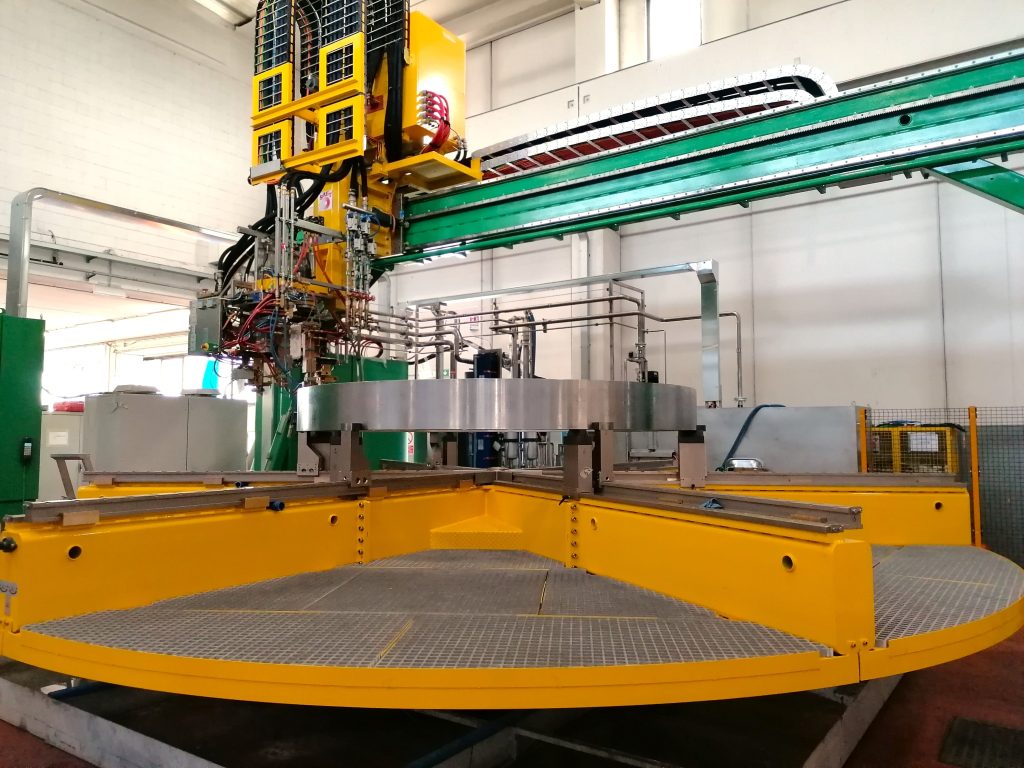
To overcome this challenge, SAET has developed a seamless hardening technology that uses independently controlled heating heads moving in a coordinated manner around the component circumference. The objective is to achieve metallurgical continuity along the entire raceway and reduce hardness differences between the beginning and the end of the treatment by optimizing the hardening process.
Eliminating soft zones does not depend solely on the mechanical configuration of the machine, but on the correct integration of frequency, power distribution, inductor geometry, scanning speed and quenching strategy. It is precisely this combination of expertise that demonstrates the value of SAET’s application experience in treating large rings and bearings.
Power and frequency in induction hardening: how they affect the treatment
For large components, simply increasing the available power is not enough.
Frequency selection directly affects:
- Heating depth;
- Temperature distribution;
- Process speed;
- Energy efficiency.
Applications requiring significant treatment depths, such as large bearings and slewing rings, frequently use lower frequencies, which allow deeper heat penetration into the material.
In applications involving large bearings and slewing rings, achieving high surface hardness alone is not sufficient. It is often necessary to achieve significant hardening depths capable of withstanding heavy loads and demanding operating conditions while maintaining good core toughness.
Inductor design makes the difference
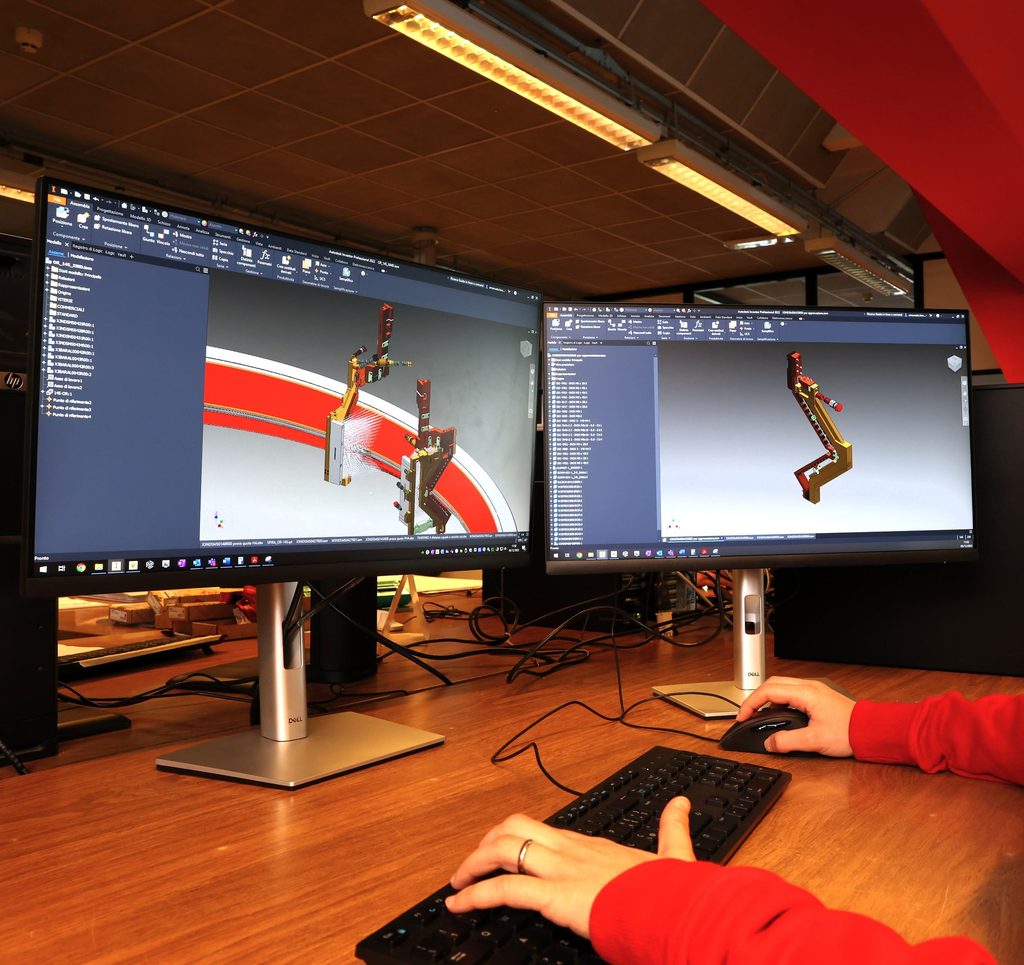
Every component requires a specifically engineered induction coil.
The design must take into account:
- Component geometry;
- Material;
- Required case depth;
- Area to be treated;
- Scanning speed;
- Coil-to-part distance.
For large rings and bearings, even small variations in the air gap can significantly influence magnetic field distribution and therefore the final treatment result.
There are no universal solutions for large components. Component geometry, steel grade, required case depth and operating conditions make it necessary to develop a dedicated treatment strategy for each application.
For this reason, technology represents only part of the solution. Equally important is the ability to develop, test and validate the process according to specific application requirements. This is precisely where SAET’s experience plays a decisive role.
Process control and repeatability
For components used in strategic industries such as wind energy, mining and construction equipment, process repeatability is essential.
Modern induction systems integrate automatic control of parameters such as:
- Power;
- Frequency;
- Scanning speed;
- Temperature;
- Quenching;
- Inductor position.
The objective is to ensure consistent results even on components several meters in diameter.
Industrial applications of induction hardening
Induction hardening of large components is used across various industrial sectors where high surface hardness, wear resistance and reliability are required, even under heavy loads and demanding operating conditions. Key applications include large bearings, slewing rings, transmission shafts and components for heavy industrial machinery.
Large bearings for wind turbines
Large slewing bearings used in wind turbines can reach several meters in diameter and must ensure reliable long-term performance while operating under severe environmental conditions and variable loads.
In these applications, induction hardening of bearing raceways makes it possible to achieve:
- High surface hardness and wear resistance;
- Case depths suited to operating conditions;
- A tough core capable of withstanding mechanical stresses;
- Reduced distortion thanks to localized heating of the areas to be treated;
- The possibility of limiting energy consumption compared with processes that require heating the entire component.
SAET solutions for large rings and bearings also allow automatic control of process parameters and uniform treatment around the entire circumference, a particularly important requirement for the reliability of these components.
Slewing rings
Slewing rings are used in industrial machinery such as excavators, cranes, mining equipment and wind turbines, where they must withstand heavy loads and rotational movements.
Induction hardening makes it possible to treat surfaces subjected to wear and mechanical stress, with particular attention to hardness uniformity and treatment continuity around the circumference. These aspects are essential to reduce the risk of areas with non-uniform mechanical properties that could compromise component reliability.
Large shafts
Large transmission shafts used in industrial machinery, agricultural equipment and construction equipment may require localized treatment in areas particularly exposed to wear and fatigue.
Selective induction heating, followed by the quenching stage specified by the hardening cycle, makes it possible to treat the required areas without necessarily subjecting the entire component to heat treatment, preserving the properties of the untreated sections.
Mining and heavy machinery components
In mining and heavy machinery applications, mechanical components are often subjected to high stresses, abrasion and continuous operating cycles.
Induction hardening increases the hardness and wear resistance of treated surfaces while maintaining the toughness required in the rest of the component. The ability to concentrate treatment on the most highly stressed areas is an advantage in applications requiring structural strength and long-term reliability.
SAET’s experience in induction hardening large components
Induction hardening of large components requires an integrated approach combining metallurgical expertise, inductor design and process parameter control. Thanks to its application experience, SAET Induction develops solutions dedicated to treating large rings, bearings and complex industrial components, including applications involving rings with diameters exceeding 10 meters.
Hardening strategies are defined according to component characteristics and specific production requirements, with particular attention to the uniformity and repeatability of results.
Contact our technical team to learn more about the available solutions or discuss a specific application.