
Induction hardening and tempering: two complementary processes
In induction heat treatment, hardening and tempering are not simply two consecutive operations. They are complementary stages that allow engineers to define the final performance of a component.
Induction hardening creates a hardened surface layer, typically characterized by a martensitic microstructure, in areas exposed to wear, contact stresses, or cyclic loading.
Induction tempering, performed after hardening at a lower temperature, helps reduce the brittleness of the newly formed martensite and improves the overall stability of the treatment result.
Together, these processes make it possible to achieve the optimal balance between surface hardness, toughness, fatigue resistance, dimensional stability, distortion control, and long-term service life.
What is induction hardening?
Induction hardening is a localized heat treatment process applied to hardenable steels. Heat is generated directly within the workpiece through electromagnetic induction and concentrated only in the areas requiring increased hardness.
The selected area is heated into the austenitizing range and then rapidly quenched. When the material and process parameters are properly defined, a martensitic layer develops in the treated zone. This microstructure provides high hardness and wear resistance but is also more susceptible to brittleness and residual stresses than the original material condition.
One of the main advantages of induction technology is its selectivity. Raceways, gear teeth, shafts, shoulders, diameters, and other specific profiles can be treated without unnecessarily heating the entire component.
This localized approach helps control case depth, distortion, and cycle time, particularly in high-volume production environments.
What is induction tempering?
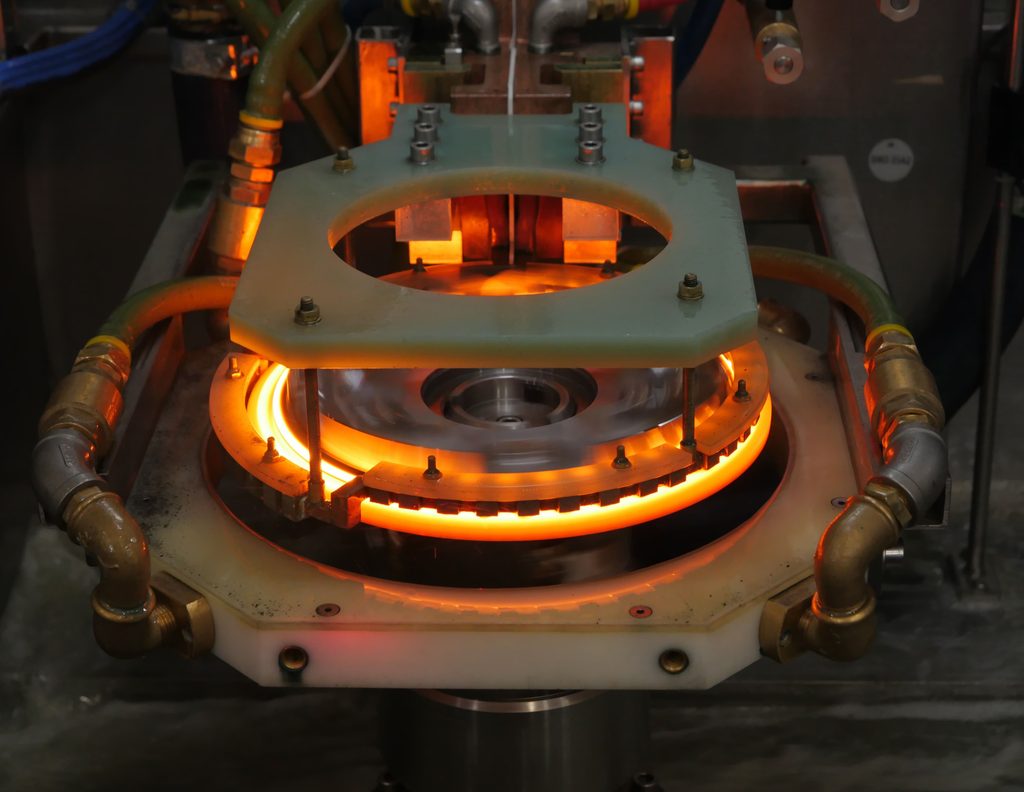
Induction tempering is a subcritical heat treatment typically performed after hardening. The component is reheated to a temperature below the austenitizing range in order to reduce residual stresses and make the hardened martensitic structure more stable and less brittle.
Tempering generally results in a controlled reduction of maximum hardness, while improving toughness, ductility, and fatigue performance. The final outcome depends on the material, tempering temperature, time, hardened depth, and actual thermal distribution achieved during the process.
The purpose of tempering is not simply to soften the component. Its role is to complete the hardening process by preserving the required hardness while making the component better suited to real operating conditions.
Why a very hard component is not necessarily a good component
When discussing heat treatment, it is easy to assume that higher hardness automatically means better performance. In reality, hardness is beneficial only when it is aligned with the component geometry, material properties, and service conditions.
An extremely hard component may become excessively brittle. Gears, shafts, and mechanical joints subjected to dynamic loads, impacts, or repeated operating cycles must not only resist wear but also absorb mechanical stresses without failure.
Induction hardening can create a highly wear-resistant surface layer. However, untempered martensite may be brittle, notch-sensitive, and characterized by residual stresses that must be carefully managed.
For this reason, the real objective is not to achieve the highest possible hardness, but to obtain the most suitable performance for the intended application.
An automotive transmission component, a large bearing, or a part subjected to cyclic fatigue do not require the same heat treatment profile. In every case, the challenge lies in finding the correct balance between surface hardness, effective case depth, toughness, fatigue resistance, and dimensional stability.
This is precisely where tempering becomes essential.
Achieving hardness is simple. Achieving the right balance requires experience
From a metallurgical perspective, hardening and tempering are two distinct heat treatment processes. In industrial practice, however, they must be designed as a single integrated cycle, because the final result depends on the interaction between heating, microstructural transformation, quenching, and subsequent tempering.
Hardening creates the wear-resistant surface layer required to withstand contact loads and abrasive conditions. Tempering reduces brittleness and residual stresses while preserving the benefits achieved through hardening. Only the correct combination of both processes can deliver components capable of maintaining reliable long-term performance.
Process parameters cannot be standardized. Different materials, geometries, and application requirements demand different treatment strategies.
Key factors that must be carefully defined include:
- Required hardening depth
- Target surface hardness
- Required fatigue resistance
- Distortion control
- Component dimensional stability
- Production cycle time requirements
This is why application know-how often becomes more important than the technology itself. A machine can generate energy. Experience transforms that energy into the performance the customer requires.
Beyond heat treatment: 60 years of SAET application expertise
For more than 60 years, SAET has been developing induction heating and heat treatment solutions for some of the most demanding industrial sectors worldwide.
Over the decades, the company has built expertise that extends far beyond the design of power generators, induction coils, and heat treatment systems.
Every application presents unique challenges. A transmission shaft, CV joint, large bearing, or energy-sector component requires a dedicated approach, both from a metallurgical and manufacturing perspective.
For this reason, every SAET project begins with a comprehensive analysis phase that includes:
- Evaluation of metallurgical objectives
- Process simulation and development
- Custom induction coil design
- Preliminary testing and validation
- Optimization of production parameters
The goal is not simply to provide equipment, but to develop a reliable, repeatable process capable of delivering consistent performance over time.
From initial testing to production: the value of SAET support
The quality of an induction heat treatment system cannot be measured solely at delivery. In many cases, the most important phase begins when the equipment enters production.
Start-up and commissioning are critical stages of any induction heat treatment project. During this phase, metallurgical results are verified, process parameters are optimized, and operators are trained.
For SAET, commissioning is not the end of a project. It marks the beginning of a long-term partnership.
SAET’s technical team supports customers throughout the entire process development and optimization phase, providing:
- Start-up and commissioning support
- Production parameter optimization
- Operator training
- Specialized technical assistance
- Ongoing after-sales support
This approach helps reduce industrialization time and allows customers to achieve target performance levels more quickly.
Do you need to develop or optimise an induction hardening and tempering process?
Contact the SAET team to discuss your requirements with our specialists and identify the most suitable solution for the metallurgical, production and application needs of your component.